(NEW YORK) — In the wake of the dramatic capture of Venezuelan President Nicolas Maduro and his wife, and the “large scale strike” by the U.S. on the country, questions abound about how the U.S. might run a country of 31 million people.
President Donald Trump stunned and alarmed many by announcing not only Maduro’s ouster, but saying that the U.S. would “run” the country temporarily, a statement that drew sharp criticism from some Democratic lawmakers and others about a new and complex foreign entanglement.
Retired Marine Corps colonel and former State Department official Steve Ganyard, an ABC News contributor, told “Good Morning America” that American involvement could go on for a “very long time.”
“The trick here will be to not disturb the underlying structure of Venezuelan society … to find somebody that will come in, provide just enough stability to lead to what hopefully will be free and fair elections,” Ganyard said.
Ganyard also said the U.S. military force that is in place is not equipped “to put boots on the ground,” if the interim government does not go along with American interests. “Those options at this point are very, very limited,” he said.
Trump expressed skepticism about not only Venezuelan opposition leader Maria Corina Machado, but also other leaders in the country, due to their connection to Maduro.
The Venezuelan Supreme Court on Saturday directed the country’s vice president, Delcy Rodriguez, to assume the presidency, citing the “exceptional situation created by the kidnapping of Nicolás Maduro Moros.”
In an address on Saturday, Rodriguez called for Maduro’s “immediate release.”
“The people must go to the streets, the armed forces must deploy across the country, and all institutions must activate — to defend what we are, as sons and daughters of Simon Bolivar,” she said during the address, in Spanish.
The statements appeared to be at odds with the characterization of her position by President Trump, who indicated that in a call with Secretary of State Marco Rubio, Rodriguez said “she’s essentially willing to do what we think is necessary to make Venezuela great again.”
“She had a long conversation with Marco, and she said, “We’ll do whatever you need.” She, I think she was quite gracious, but she really doesn’t have a choice. We’re going to have this done right,” Trump said during a press conference at Mar-a-Lago on Saturday.
Rubio, for his part, reserved judgment about Rodriguez’s comments. “We’re going to make decisions based on their actions and their deeds in the days and weeks to come,” he said in an interview with The New York Times.
ABC News has reached out to the State Department for comment.
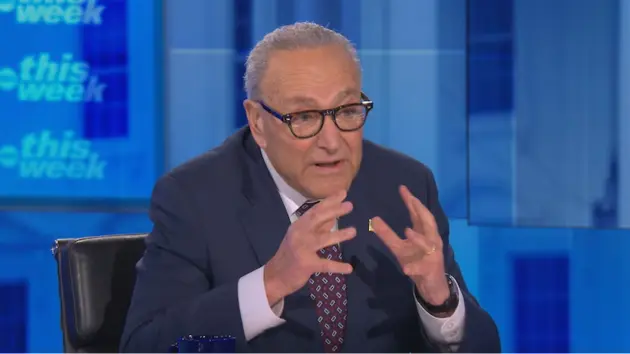
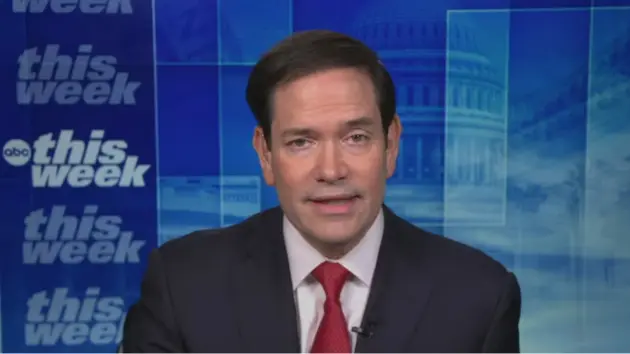
During an appearance Sunday on ABC’s “This Week,” Rubio said that the administration was not recognizing Rodríguez as the current legitimate leader in Venezuela.
“We don’t believe that this regime in place is legitimate via an election,” Rubio said.
The implications of Trump’s pronouncement that the U.S. was going to “run” Venezuela were not immediately clear.
The president suggested during his press conference Saturday that some of his Cabinet officials could undertake the task in coordination with a team of people in Venezuela. He also did not rule out “boots on the ground” from the American military.
“We can’t take a chance of letting somebody else run it and just take over what he left, left off, so we’re making that decision now,” Trump said. “We’ll be involved in it very much. And we want to do liberty for the people.”
Trump also said that the opposition leader, Machado, does not have the “respect” needed to run the country. Political analysts interviewed by ABC News rejected Trump’s assessment of Machado.
A U.S. official said the Trump administration would engage diplomatically with the remainder of the Venezuelan government, engage with oil executives to rebuild the infrastructure, that the American military would remain at the ready, that the oil embargo would remain in place and the administration would continue to dismantle cartels. Beyond that, the plan was not immediately clear.
On “This Week” Sunday, when pressed on whether the U.S. was in charge of Venezuela right now, Rubio said that what the U.S. was “running” was the “direction” of the situation.
“What we are running is the direction that this is going to move moving forward. And that is we have leverage,” Rubio added.
Copyright © 2026, ABC Audio. All rights reserved.