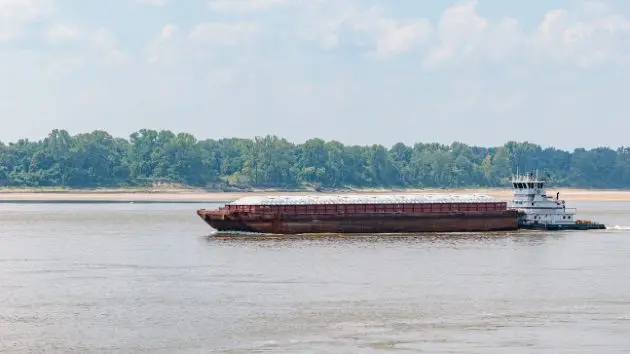
(WASHINGTON) — Mayors from Minnesota to Louisiana traveled to Washington earlier this month with a bipartisan message that protecting the Mississippi River is not just an environmental issue, it is a matter of national security.
The mayors met with lawmakers and federal officials, including the Environmental Protection Agency and the Department of Homeland Security, as part of their annual Mississippi River Cities & Towns Initiative fly-in, and later spoke with ABC News about growing pressures facing the river corridor.
Stretching more than 2,300 miles through 10 states, the Mississippi River forms the backbone of one of the most important economic corridors in America. According to data shared by the mayors’ coalition, the river system generates nearly $500 billion in annual revenue and directly supports about 1.5 million jobs.
Its waters also carry a massive share of the nation’s agricultural exports, making the river central to U.S. and global food supply chains. According to the National Park Service, the Mississippi River Basin accounts for 92% of America’s agricultural exports, including 78% of the world’s exports of grains and soybeans.
Founded in 2012, the Mississippi River Cities & Towns Initiative (MRCTI) brings together local governments along the river corridor to coordinate priorities including clean water, economic stability, disaster resilience and food security.
However, this year’s trip to Washington came with new urgency.
Several mayors said the rise of artificial intelligence, declining infrastructure, growing demand for water and energy, geopolitical tensions in the Middle East affecting fuel prices and increasingly severe weather events are placing unprecedented pressures on the region.
One concern raised during the discussions was growing interest from water-scarce regions in the western U.S.
“The Colorado River Basin is looking at the Mississippi River Basin to move water into areas of Phoenix, Vegas — the places that are most water insecure on the continent,” Colin Wellenkamp, executive director of MRCTI and a Missouri state representative, told ABC News.
He added they “are looking into the Mississippi River basin for their water supply for the future.”
Coalition co-chair Mayor Melisa Logan of Blytheville, Arkansas, said the river system has become a national security concern as water demands grow.
“This water is absolutely essential for the security of the country, and you move it to another basin irresponsibly, right? That puts the nation at risk,” Logan told ABC News.
Several major U.S. water systems are already governed by interstate compacts, including the Great Lakes Water Compact and the Delaware River Basin Compact. These legally binding agreements, often approved by Congress, help to establish rules for managing and protecting shared water resources.
Supporters of a Mississippi River Compact say a similar framework could help coordinate policy across the 10 states that rely on a basin that supports national and international trade and food supply chains.
“That’s why these mayors are pursuing a Mississippi River Compact to protect the Mississippi,” Wellenkamp said.
He noted that his state passed a law for such an agreement.
“The other nine states aren’t far behind, because this is a real risk in the future,” Wellenkamp added.
Beyond water access, many mayors said the rising cost of disasters has become another urgent concern for communities along the river.
Logan, Blytheville’s mayor, said protecting the river requires key coordination across state lines, as communities along the river often struggle to secure federal funding for projects that cross state boundaries.
“Typically, they do it state by state by state,” Logan said, referring to federal funding programs. “But these impacts are multi-state by watershed.”
According to MRCTI materials, natural disasters along the Mississippi River corridor have caused more than $250 billion in losses since 2005.
Mayor Buz Craft of Vidalia, Louisiana, said local leaders often face delays when seeking federal disaster assistance.
“We need Congress to quit changing the goal post, for example, when we have an issue, whether it’s a tornado or hurricane,” he said.
Changing White House administrations can also put them back to square one, Craft noted.
“Just when you are about to get that funding for that past disaster they say ‘Oh, now you got to go through this,’ start all over and apply to this program, and it’s really a rat race,” he said.
Global instability is also beginning to show up in everyday costs for residents along the river. Several of the mayors said fuel prices along the Mississippi River recently jumped about 20 cents overnight. Those increases can quickly ripple through food prices, the mayors said, because much of the nation’s food supply moves by truck, rail or barge along the Mississippi River system.
Meanwhile, some communities are also preparing for a different kind of pressure, the rapid expansion of artificial intelligence infrastructure. The data centers that power AI systems require massive amounts of electricity and water for cooling, placing new increased demands on local power grids and water systems.
Mayor David Goins of Alton, Illinois, said companies have already begun exploring potential sites in his city.
“I think it’s important to get in front of it and get ahead of it,” he said. “This meeting right here is timely to get the resources that we can, that we can have at our disposal through different companies, organizations, to start preparing ordinances and start getting some type of framework or groundwork, because it’s coming.”
For the mayors gathered in Washington, the message they hoped policymakers would hear was simple: the Mississippi River’s importance stretches far beyond the cities along its banks.
“If you don’t live on the Mississippi River, you don’t necessarily understand the importance of the Mississippi River Basin to our entire continent,” Quincy, Illinois, Mayor Linda Moore said. “One in 12 people in the world is fed by food that flows up and down the Mississippi on a barge or from the river itself.”
For the mayors who traveled to Washington this week, the Mississippi River is more than a waterway — it is an economic lifeline whose currents shape American agriculture, trade and communities across the country.
Mayor Hollies Winston of Brooklyn Park, Minnesota, said the river’s influence reaches far beyond the 10 states it touches, and may stretch long into the future.
“If that water is not protected, we don’t know the impact that that has on the economy 15, 20, 30 years from now,” Winston said.
Copyright © 2026, ABC Audio. All rights reserved.