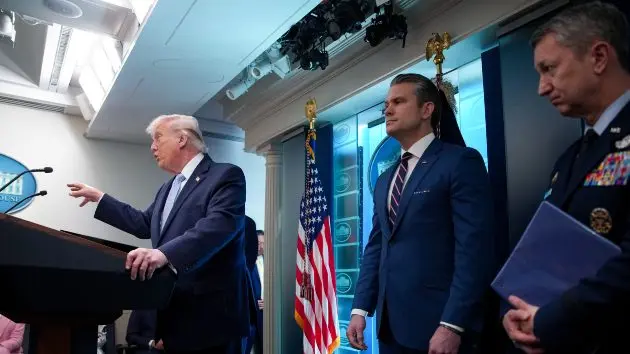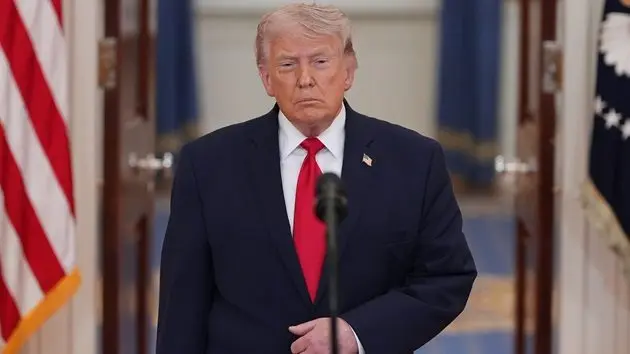
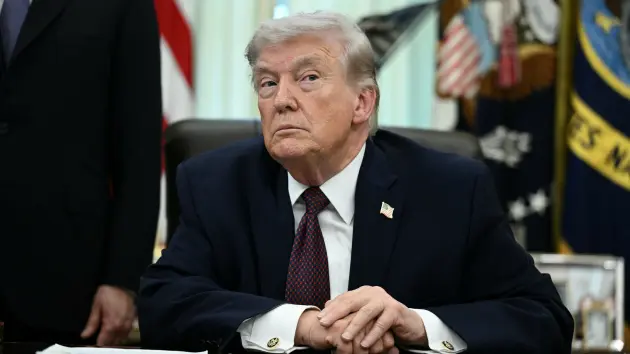
(WASHINGTON) — President Donald Trump on Monday shared new details about the harrowing lengths a U.S. aviator shot down in Iran went through to keep himself alive and the scope of the mission to rescue him.
“Despite the peril, the officer followed his training and climbed into the treacherous mountain terrain and started climbing toward a higher altitude, something they were trained to do in order to evade capture,” Trump recounted in a briefing on the operation to the media. “He scaled cliff faces, bleeding rather profusely, treated his own wounds, and contacted American forces to transmit his location.”
Trump said the weapons system officer, who ejected along with the pilot from an F-15 fighter jet, was “injured quite badly” and stranded in an area “teeming” with members of the Iranian Revolutionary Guard Corps, militia and local authorities.
The pilot was rescued in a separate and challenging broad daylight mission on Friday.
But finding the second aviator, who landed miles away, was “comparable to hunting for a single sand of grain of sand in the middle of a desert,” CIA Director John Ratcliffe said.
Trump said the U.S. has taken out Iran’s radar and air defense capabilities but the F-15 was shot down by a shoulder-launched, heat-seeking missile.
“They had probably a little luck because you got to get lucky,” the president said.
Trump said the second rescue mission involved involved “hundreds” of service members and 155 aircraft, including four bombers, 64 fighters, 48 refueling tankers, 13 rescue aircraft and others, as well as efforts to deceive the Iranians about where U.S. forces were searching.
“We had seven different locations where they thought, and they were very confused,” Trump said of the Iranians.
Secretary of Defense Pete Hegseth described Iran’s military as “embarrassed and humiliated” by the rescue.
Trump said the Central Intelligence Agency was responsible for finding “this little speck” in the mountainous area in which he was hiding.
Ratcliffe, the CIA director, said the U.S. deployed both human assets and “exquisite technologies that no other intelligence service in the world possesses” to locate the weapons system officer on Saturday, who was “concealed in a mountain crevice, still invisible to the enemy, but not to the CIA.”
Ratcliffe said some of the unique capabilities the CIA used are ones that only the president can deploy and that he would not publicly divulge what they were.
“As an agency, the CIA possesses unique capabilities that only the president can deploy. Some of these capabilities fall under covert action authorities. And because covert means exactly that, I’m not going to be able to tell you everything that you want to know,” Ratcliffe said.
Ratcliffe said finding the downed aviator was “comparable to hunting for a single sand of grain of sand in the middle of a desert.”
“This was also a race against the clock, as it was critical that we locate the downed aviator as quickly as possible, while at the same time keeping our enemies misdirected,” he added.
Hegseth said once the airman turned on his transponder, his first message was “God is Good.”
“In that moment of isolation and danger, his faith and fighting spirit shown through,” Hegseth said.
Trump said once it was determined that the two airplanes used to ferry in troops and equipment could not take off from the soft, wet sand in the makeshift landing area, “we blew them up to smithereens” so that the technology they carried couldn’t be captured by the Iranians.
“And we had a contingency plan, which was unbelievable, where lighter, faster aircraft came in and they took them out. We blew up the old planes. We blew them up to smithereens, because we had equipment on the planes that, frankly, we’d like to take, but I don’t think it was worthwhile spending another four hours there taking it off,” he said.
ABC News’ Mariam Khan contributed to this report.
Copyright © 2026, ABC Audio. All rights reserved.