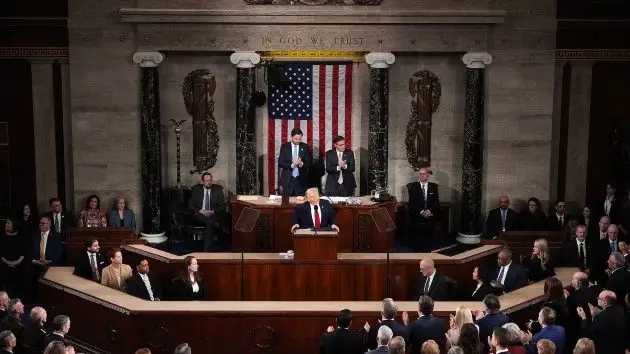
(WASHINGTON) — During his State of the Union address Tuesday, President Donald Trump awarded two Congressional Medals of Honor, the nation’s highest decoration for valor in combat — one for heroism from more than 70 years ago and the other for heroism in the most recent U.S. military action.
One of the recipients was Chief Warrant Officer 5 Eric Slover, a special operations helicopter pilot severely wounded in the raid that captured Venezuela’s President Nicolás Maduro. As Slover’s Chinook swept in, rounds fired from the ground tore through the cockpit and into his legs and hip.
“Eric was hit very badly in the leg and hip, one bullet after another. He absorbed four agonizing shots, shredding his leg into numerous pieces,” Trump said as Slover stood with the aid of a walker.
Slover was presented the award by Lt. Gen. Jonathan Braga, the commander of U.S. Special Operations Command, a break from tradition in which the president personally presents the award.
In recent decades, the review and awarding the Medal of Honor comes after exhaustive reviews and interviews with witnesses that can drag on for years. That had become the norm with heroic actions that occurred in the wars in Iraq and Afghanistan.
But the announcement of Slover’s award marks a break with that pattern as he was awarded the medal just 52 days after his mission, a short turnaround similar to what was seen in World War II.
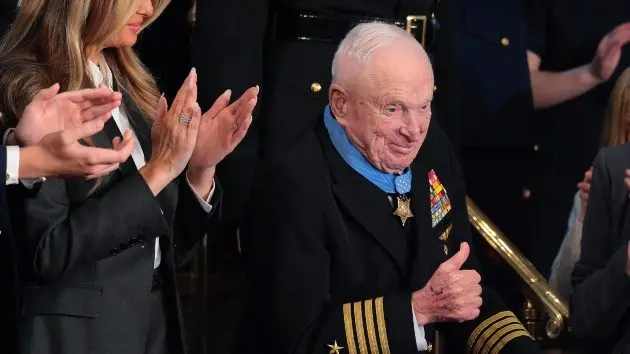
First lady Melania Trump presented the second Medal of Honor to retired Navy Capt. E. Royce Williams, a 100-year-old retired Navy captain whose extraordinary dogfight during the Korean War remained classified for decades, even to his wife, as the encounter could have ignited World War III.
“At 100 years old, this brave Navy captain is finally getting the recognition he deserves,” Trump said. “He was a legend long before this evening.”
According to Navy records, on Nov. 18, 1952, during the Korean War, Williams launched from an aircraft carrier on what was supposed to be a routine patrol. Then came a warning that seven MiG-15s were inbound. The three other American aircraft in Williams’ formation were unable to engage with the MiGs.
The MiGs he faced were Soviet aircraft flown by Soviet pilots at a time when the Soviet Union was not officially a combatant in the conflict. Public acknowledgment of the clash risked escalating into direct confrontation between nuclear powers, a step that, in 1952, many feared could ignite a third world war.
What followed was 30-minutes of aerial combat. By the time it ended, he had shot down four enemy jets. His own aircraft, a F9F-5 Panther, was riddled with more than 250 bullet holes, yet he managed to guide it back to the carrier and land safely on deck.
There was no celebration waiting for Williams. Instead, he was told he could not speak about what had happened and the encounter was immediately classified. He didn’t even tell his wife until the 1990s, when the records of the fight were declassified.
ABC News’ Luis Martinez contributed to this report.
Copyright © 2026, ABC Audio. All rights reserved.