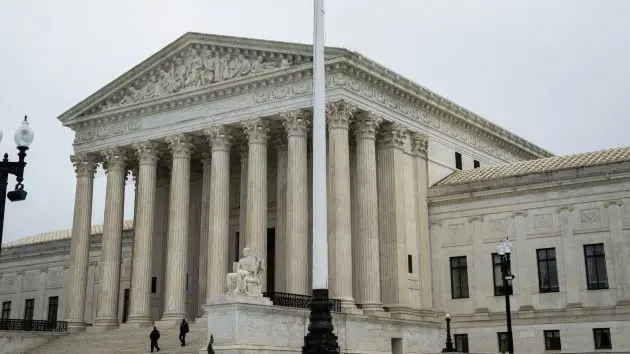
(WASHINGTON) — The Supreme Court on Wednesday ruled in favor of a U.S. Army veteran wounded in a 2016 suicide bombing in Afghanistan, allowing him to sue a military contractor for damages after it allegedly failed to supervise the attacker who was an employee.
The 6-3 decision reverses lower court rulings which had said the contractor, Fluor Corporation, was immune from lawsuits because it was operating on behalf of the U.S. government and opens the door to other damages suits against war-zone contractors for activities outside the bounds of their responsibility.
The attacker, Ahmad Nayeb, was employed by Fluor to work in a nontactical vehicle yard on Bagram Air Base under an Army contract that required the company to ensure all personnel complied with base security policies, which included their confinement to works sites and “constant view of them.”
In November 2016, Nayeb roamed the base freely for nearly an hour and used U.S. government tools to make his bomb inside the secure base, according to an Army investigation cited in court documents.
The explosion killed five and wounded 17, including then-Army Spc. Winston Hencely, who confronted the attacker just as he detonated his suicide vest. Nayeb was killed; the explosion fractured Hencely’s skull and resulted in permanent disability.
While damages claims against the U.S. government and its military contractors arising out of combatant activities are generally prohibited by federal law, Justice Clarence Thomas, writing for the court’s majority, concluded immunity does not apply to cases when “the contractor was not required or authorized to take the action at issue.”
“The government required Fluor to hire Afghan employees and to provide logistics for Bagram Airfield. But, it did not, Hencely contends, require Fluor to leave Nayeb unsupervised, allow him to walk alone for an hour after his shift, or permit him to obtain unauthorized tools with which he could build a bomb,” Thomas wrote.
The decision clears the way for Hencely to pursue a damages case against the company in federal court.
In dissent, Justices Samuel Alito and Brett Kavanaugh and Chief Justice John Roberts said while they believe Hencely deserves “a full measure of support from the American people,” a damages lawsuit is “not the way to give the petitioner what he is due.”
Alito wrote, “War is the exclusive domain of the Federal Government, but the Court [today] allows state (or foreign law) to encroach on that domain. The Constitution precludes that encroachment.”
Fluor Corp, which disputes liability for the bombing, did not immediately respond to ABC News’ request for comment on the court’s decision.
Copyright © 2026, ABC Audio. All rights reserved.